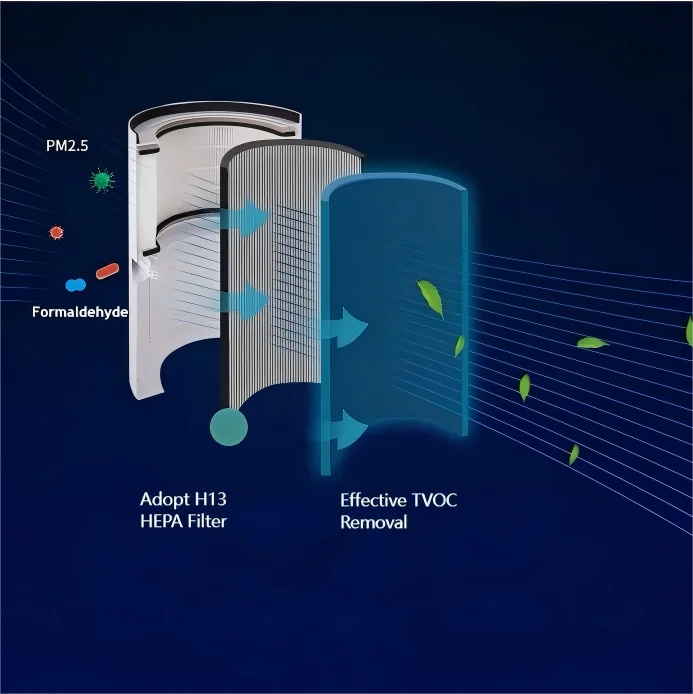
Every air purifier advertisement claims it helps with allergies. The American College of Allergy, Asthma & Immunology (ACAAI) has a more measured response: the scientific evidence exists, but it is more complicated than the marketing suggests.
We looked at the peer-reviewed research and what actual clinical studies tell us about who benefits—and who does not.
What the Clinical Research Actually Shows
A 2024 meta-analysis published in MDPI reviewed multiple randomized controlled trials on air purifiers for allergic rhinitis. The conclusion: air purifiers with true HEPA filtration show “moderate evidence” of improving symptoms for patients sensitized to indoor allergens, particularly dust mites and pet dander.
The key finding from PubMed research (PMC3165134): air purifiers are most effective when they run continuously in the room where someone sleeps, not in a common area or intermittently. Most allergen exposure happens during sleep when you are breathing deeply in a contained space.
For pet dander specifically, the ACAAI notes that HEPA purifiers can reduce airborne allergen counts by 50-70% when sized appropriately for the room. This will not eliminate allergies to cats or dogs entirely, but it measurably reduces symptom severity for mild to moderate sufferers.
The UV and Ionic Purifier Problem
Here is where the science gets uncomfortable for certain brands: air purifiers using UV light or ionizers to “kill” bacteria and allergens have no proven clinical benefit for allergy treatment, according to ACAAI.
In practice, multiple studies show these technologies do not reliably reduce allergen loads in real-world home conditions. Worse, some ionizers produce trace amounts of ozone as a byproduct, which can actually irritate respiratory systems.
The recommendation from ACAAI clinical practice guidelines (updated 2024): if you are buying an air purifier specifically for allergy relief, stick with HEPA-only filtration. Skip the ionizer and UV features—they add cost without clinical benefit.
Room Size and ACH: The Technical Detail That Matters
Air Change Per Hour (ACH) measures how many times per hour an air purifier can cycle all the air in your room through its filter.
The sweet spot for allergy relief, according to multiple studies, is 4-6 ACH. That means a 200-square-foot room with 8-foot ceilings (1,600 cubic feet of air) needs an air purifier that can move 6,400-9,600 cubic feet per hour through filtration.
Many small air purifiers marketed for bedrooms only achieve 2-3 ACH—enough to improve air quality gradually, but not enough for fast allergen reduction during peak exposure times.
IQAir technical documentation explains that their medical-grade units are designed to hit 6+ ACH in typical bedroom sizes, which is why allergists frequently recommend their products—but at a price point 5-10x higher than consumer models.
Who Should Buy (And Who Should Not Bother)
Worth it if:
- You have confirmed dust mite or pet dander allergies
- You live in an area with poor outdoor air quality
- Your bedroom is the primary space where symptoms occur
- You want to reduce medication use alongside other treatments
Probably not worth it if:
- Your allergies are primarily seasonal pollen (outdoor air comes in continuously)
- You have mold allergies without addressing the underlying moisture problem first
- You are expecting it to “cure” allergies rather than reduce symptoms
- Your room is too large for the purifier to achieve adequate ACH